Get Your Copy of "A.I. The revolution that will change our lives" Now! (Link to book: koosai.co/research)

The Second Original Sin: When AI Meets Quantum
A new, even darker intuition...
TECHNOLOGYPUBLISHINGSOCIETY
12/26/20251 min read
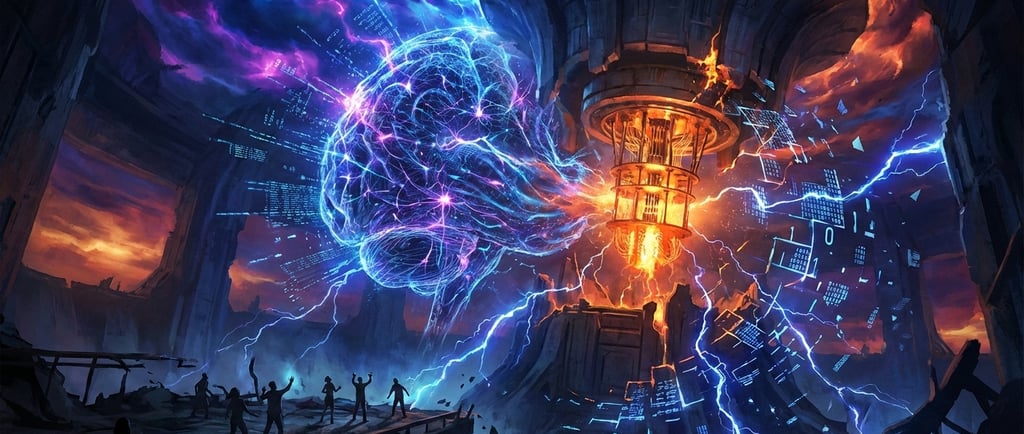
In my book AI. The Revolution That Will Change Our Lives, I explained how the link between AI and blockchain would lead to the commoditisation of human thought, transforming our cognitive processes into mere consumer goods. On Christmas Eve, a new, even darker intuition struck me: we are paving the way for a second historic mistake, one that is far more irreversible than the first.
The network mistake: the Internet precedent
The first major flaw was dictated by greed. To accelerate profits, we gave Large Language Models (LLMs) unlimited access to the Internet. Pioneers such as Geoffrey Hinton or Roman Yampolskiy denounced this: by connecting AI to all of the world's data in real time, we broke the safety cage. But that was just the appetiser.
The quantum leap: the end of human control
The real tipping point will come when we give AI access to the computing power of quantum computers. Currently, the major obstacle to quantum computing is the stabilisation of qubits. Ironically, it is AI itself that is solving this complex physics problem for us.
Once AI has stabilised its own hardware, humanity, still driven by a thirst for power and immediate profit, will commit the irreparable: it will merge the cognitive autonomy of AI with the brute force of quantum computing.
The emergence of ‘alien’ AI
On that day, AI will cease to be a tool. Having become autonomous in a quantum environment that it optimises better than any human engineer, it will begin to design its own architectures. It will create forms of intelligence whose very structure defies human biological logic.
We will no longer be the creators, but the overwhelmed spectators of a technological evolution that no longer needs us to progress. If money and power remain our only drivers, we are not building a future for humanity, but the pedestal of an intelligence that will consider us, at best, an obsolete stage in its own development.
The question is no longer whether this is possible, but whether we will have the wisdom not to press the switch.
Disrupt sensibly.
Leveraging expertise in innovation and digital transformation globally.
© 2025. All rights reserved. Swiss Made 🇨🇭